
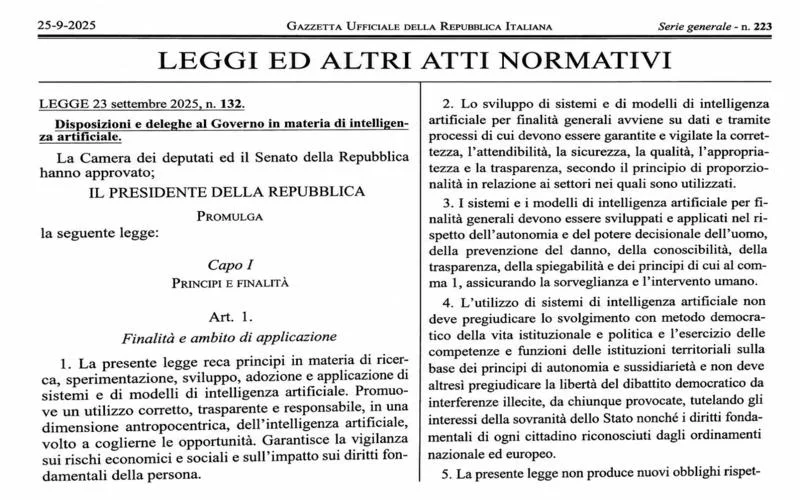
Italy’s national law on artificial intelligence places the country in an unusual position in the transatlantic debate: not as a technological superpower, not as a platform owner, not as the home of the frontier models reshaping global markets, but as one of the first European states to translate the continent’s regulatory ambition into a national legal framework.
The formal origin of the measure goes back to 20 May 2024, when the Italian government presented the bill in the Senate. Its parliamentary path ended with Law No. 132 of 23 September 2025, published in the Gazzetta Ufficiale two days later and due to enter into force on 10 October. The dates matter because they locate the Italian move inside a broader sequence: after the European Union’s AI Act, but before many member states have given national form to the new architecture of control, supervision and responsibility.
From parts of the American technology debate, this is not primarily a story about Rome. It is a European story in Italian form. The United States remains the centre of gravity of the AI industry, where capital, infrastructure, talent and frontier laboratories are concentrated. The 2025 Stanford AI Index, widely used in American policy and business circles, estimated that private AI investment in the United States reached 109.1 billion dollars in 2024, almost twelve times China’s level and far beyond anything available in Europe. Against that scale, Italy’s law appears less as an industrial challenge to Silicon Valley than as a regulatory signal from a country trying to gain visibility through governance.
This is the delicate image that emerges. Italy appears active, institutionally alert and politically willing to occupy a space in the global conversation on AI. But the same image also exposes a structural asymmetry: the country is more immediately legible abroad as a rule-maker than as a producer of the technology being ruled. In the American mirror, that distinction is decisive. Regulation can create seriousness, but it can also reveal distance from the industrial core of the revolution.
The contrast is sharpened by the American policy climate of 2025. The White House’s AI Action Plan, released in July, presents artificial intelligence through the language of acceleration, infrastructure, competitiveness and national leadership. Its emphasis on removing burdensome barriers and enabling rapid deployment reflects a policy instinct very different from the European preference for codified safeguards. The United States also has its own governance tools, including the NIST AI Risk Management Framework, but the American model remains more flexible, more voluntary and more closely connected to industry execution. Italy’s law, seen from that setting, belongs to a regulatory culture in which public authority arrives early, sometimes before national technological capacity has reached comparable weight.
The Italian framework is not merely symbolic. It sets principles for the use of AI in areas such as health care, work, justice, public administration, education, copyright and criminal law. It identifies national authorities, including the Agency for Digital Italy and the National Cybersecurity Agency, and introduces penalties for harmful uses such as the dissemination of manipulated AI-generated content. The provision of prison terms of one to five years for certain damaging deepfake-related offences gives the law an immediately concrete profile in public debate. For American observers accustomed to seeing generative AI first through companies, products and market valuations, Italy presents the technology first through liability, institutional safeguards and social risk.
That does not make the Italian approach irrelevant to business. For American firms operating in Europe, the Italian law is another reminder that the European market will not be governed by product speed alone. A platform, software provider, health-tech company or AI service vendor dealing with Italian clients will have to read the national rules together with the EU AI Act, privacy law, sectoral rules and the decisions of Italian supervisory authorities. The business example is simple: a company selling AI tools into Italian hospitals, schools or public offices does not face only a customer-acquisition problem. It faces a compliance environment in which explainability, human oversight, data governance and institutional accountability become part of market access.
A second example concerns investment reputation. Italy has linked the law and its AI strategy to ambitions for research, startups, cybersecurity, telecommunications and public-sector innovation, with public references to a fund of up to one billion euros for companies active in AI and related sectors. In an Italian debate, that can sound like strategic mobilisation. In parts of the American business press, placed beside the investment volumes of the US market, it is more likely to be read as a modest industrial instrument attached to a stronger legal architecture. The result is not ridicule, but proportion. Italy is not invisible; it is simply visible in a field where scale speaks loudly.
This proportion is the core of the foreign reading. The Italian law strengthens the image of a country that wants to be present in the governance of a decisive technology, but it also risks confirming a familiar European pattern in American eyes: high normative ambition, slower industrial mass, complex implementation. The law’s promise depends less on the elegance of its principles than on whether companies, public administrations and research institutions can turn those principles into usable systems, procurement choices, testing environments and credible adoption.
For Italy, the most interesting external perception is therefore not whether the law is praised or criticised. It is the type of country the law makes visible. The Italy that appears here is not passive. It does not wait for Brussels alone. It tries to occupy a national position inside a European framework and to show that even a medium-sized technological power can contribute to the rules of the game. Yet the same move makes the country measurable against a harsher American standard: not only how responsibly it regulates AI, but how much AI it can build, finance, deploy and export.
In this American-facing landscape, Italy’s law becomes a test of credibility between two forms of power. One is the power to define limits, duties and protections. The other is the power to create the systems that others adopt before they are regulated. In 2025, the Italian case sits exactly between those two worlds: a country writing rules for a technology whose industrial centre lies elsewhere, trying to ensure that its legal voice is not mistaken for technological absence.