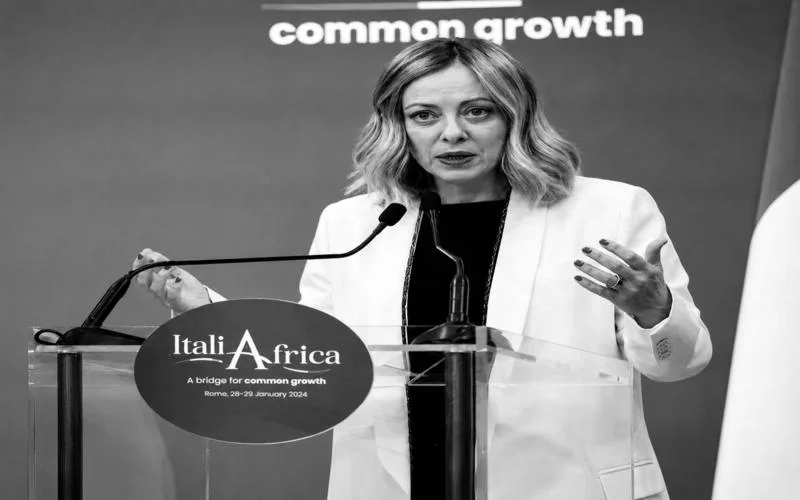
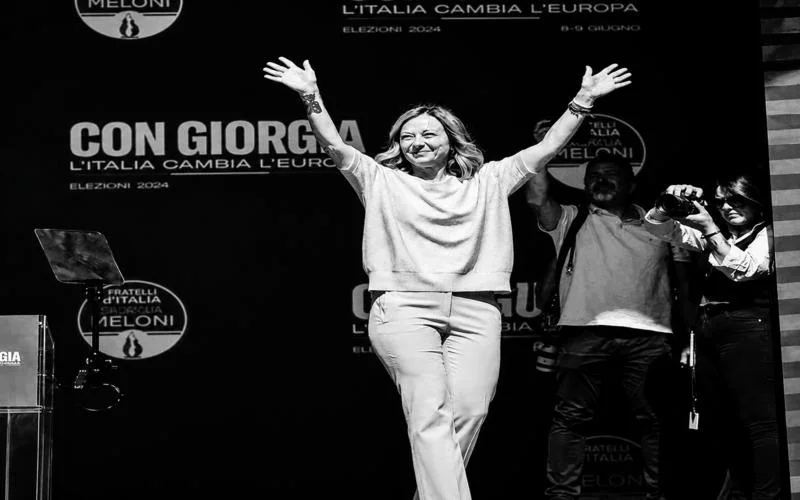
Giorgia Meloni’s success in the European elections is not being read in parts of the French debate merely as another Italian political result. It is being placed beside a French shock. On the same evening in which Fratelli d’Italia confirmed itself as Italy’s leading political force, Emmanuel Macron responded to the defeat of his European list by dissolving the National Assembly and calling snap legislative elections for 30 June and 7 July. The contrast has become difficult to avoid: Italy, so often described from Paris as politically unstable, now appears as one of the more governable large countries in the European Union, while France enters a period of institutional risk.
The Italian figures explain only part of the story. Fratelli d’Italia obtained about 28.9 per cent of the vote, improving on the 26 per cent won at the 2022 general election, while turnout remained historically low, around 49.6 per cent. The result is therefore not a plebiscite in the classical sense. Yet in the French lens its significance lies elsewhere: Meloni has not simply survived a European vote; she has turned it into confirmation of continuity. In a European cycle that has weakened several governing parties, the Italian prime minister has emerged with a stronger domestic mandate and a clearer position in the negotiations that will shape the next European institutional balance.
This is why the French reading is so revealing. French coverage does not only observe the rise of the Italian right. It measures Italy against the sudden fragility of France itself. The Rassemblement National won more than 31 per cent of the vote in France, while the presidential list led by Valérie Hayer fell to about 14.6 per cent. That gap did not remain an electoral statistic; it immediately became an institutional event. Macron’s dissolution transformed a European election into a national crisis of authority. Seen from this angle, the Italian result becomes less a story about ideology than about political usability: which government, after the European vote, can still act with predictable authority?
In several French accounts, Meloni is therefore treated as one of the few leaders of a major EU country to come out strengthened. Euronews framed her as the most stable leader among the large member states after setbacks for the governing majorities in France and Germany. Le Monde similarly placed her victory in a broader European contrast, noting that she could now claim to lead one of the most stable executives among the Union’s major countries. This does not amount to admiration without reservation. French observers remain attentive to the nature of her majority, to her dialogue with Marine Le Pen’s Rassemblement National, and to the possible implications for the European right. But the image produced is nevertheless striking: Italy is no longer appearing first as the weak link of European governance.
That reversal matters. For years, Italian politics was often simplified abroad through familiar categories: short-lived governments, unstable coalitions, leaders who rise quickly and disappear just as quickly. The June vote complicates that template. Through the French mirror, Italy now appears as a country where a strongly identified political leadership has been able to convert national legitimacy into European leverage. The figure of Meloni is the visible entry point, but the broader subject is Italy’s institutional posture. The question being raised abroad is not simply whether she is popular, but whether Rome can now weigh more heavily because it is less exposed to immediate domestic disruption than Paris.
This perception has concrete consequences. In European negotiations, stability is a form of currency. A government that can speak with a consolidated parliamentary base and a confirmed electoral result enters discussions differently from a government facing an emergency legislative campaign. On files such as the next Commission, industrial policy, migration, fiscal rules or the balance between the European People’s Party and the conservative right, Italy’s room for manoeuvre is enlarged not only by votes but by timing. Rome can appear as a negotiating actor with continuity, while Paris must devote political energy to managing the consequences of its own electoral shock.
The business reading follows the same logic. For companies, investors and trade associations observing Europe from France, the issue is not whether they share Meloni’s political orientation. The issue is whether Italy looks administratively readable. A country whose government has just strengthened its position may offer a clearer line on regulation, energy, infrastructure, defence procurement or EU funding than a country entering a snap election campaign. In reputational terms, this is a significant shift. Italy does not become automatically efficient or structurally resolved. Its public debt, low growth, regional disparities and bureaucratic weaknesses do not disappear. But the foreign hierarchy of risk can change: political volatility, for the moment, appears less Italian and more French.
The French debate also shows the limits of this new image. Meloni’s success is interpreted through the rise of the European right, and therefore partly through French domestic anxiety about Marine Le Pen and Jordan Bardella. Italy is observed not only as a stable country, but as a possible preview of a conservative-national model that parts of the French political system fear, study or hope to emulate. This makes the perception ambivalent. Stability may increase Italy’s weight, but the ideological meaning attached to that stability can also produce suspicion. For some French commentators, Rome becomes evidence that the right can govern within European institutions; for others, it becomes a warning about the normalization of forces once kept at the margins.
That ambiguity is central to the Italy now visible from France. The country is not being seen simply as a success story. It is being seen as an anomaly: a historically unstable political system that, in this European moment, looks more stable than the French one. This image is powerful precisely because it overturns an old assumption. Italy’s reputation abroad has often suffered from the belief that it could produce talent, diplomacy and economic resilience, but not durable political direction. The June 2024 vote allows a different idea to circulate: Italy as a country whose leadership can translate domestic consolidation into European bargaining power.
The decisive point is not whether this image will last. From the standpoint of June 2024, what matters is that it exists. French observers are looking at Rome while Paris absorbs the consequences of Macron’s gamble. In that comparison, Italy becomes more than the country of a strengthened prime minister. It becomes a mirror in which France sees its own fragility — and in which Italy, unusually, appears as the more governable European actor.