By October 2025, the crisis of Stellantis in Italy is no longer a dispute over a carmaker’s production cycle. Seen from France, it has become a test of what remains of Italian industrial sovereignty inside a group that was born from a Franco-Italian-American compromise and now has to decide where Europe’s automotive future will actually be built.
The official origin of that ambiguity dates back to 16 January 2021, when the merger between PSA and Fiat Chrysler Automobiles became effective, creating Stellantis. At the time, the new company was presented as a balanced construction: Peugeot, Fiat, Jeep, Citroën, Alfa Romeo, Opel, Maserati and other brands under one roof, with Paris, Turin and Detroit still visible in the corporate geography. But in the French reading of the current Italian crisis, the balance looks less symbolic than it once did. The question is no longer whether Italy has historic automotive brands. It is whether those brands still guarantee production, employment, engineering continuity and decision-making weight on Italian soil.
French business and industrial coverage has not treated the Italian case as a purely domestic quarrel between Rome, unions and a multinational group. In Le Monde’s economic coverage in October 2024, the Italian problem appeared inside a broader reassessment of the “Tavares method”: aggressive cost control, high margins, pressure on plants and a strategy increasingly exposed to the weakness of demand. The Italian element was striking because it showed the limits of that model where industrial memory is strongest. The newspaper noted that production in Stellantis’s Italian plants had fallen sharply in the first nine months of 2024, with Maserati suffering an especially dramatic collapse, while Mirafiori, the historic Turin plant associated with Fiat’s industrial identity, was repeatedly stopped.
That is the first image of Italy that emerges in the French mirror: not a country without industry, but a country whose industrial symbols no longer automatically protect its industrial mass. Mirafiori still carries enormous narrative power. Maserati still evokes Italian high-end manufacturing. Alfa Romeo and Fiat still belong to a recognisable national imagination. Yet the foreign industrial eye looks less at memory than at volumes, platforms, model allocation and battery investments. When those move elsewhere, the brand remains Italian in perception but the industrial centre of gravity begins to look negotiable.
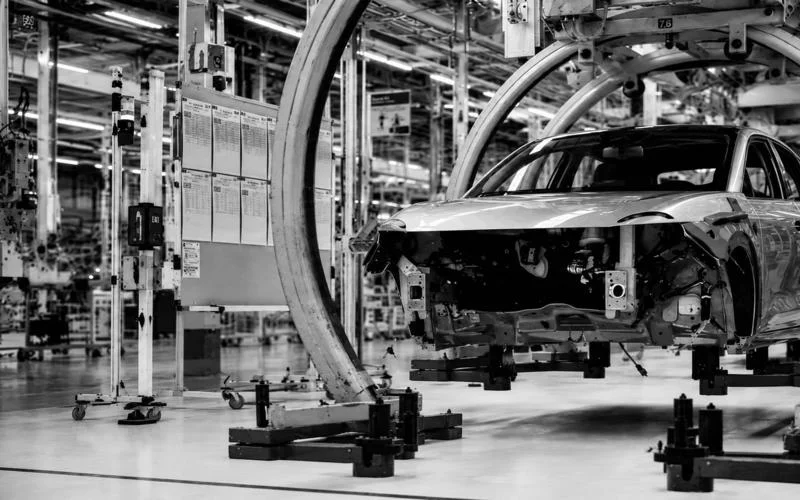
The figures made that perception harder to dismiss. FIM-CISL estimated that in the first half of 2025 Stellantis produced 221,885 vehicles in Italy, down 26.9 percent from the same period of 2024. Passenger cars fell by 33.6 percent to 123,905 units. French specialist coverage in L’Argus used those figures to describe a crisis affecting all six Italian plants, from Atessa and Pomigliano to Melfi, Mirafiori, Cassino and Modena. The detail matters because, from a French industrial perspective, this is not only a fall in output. It is the loss of saturation across a national manufacturing network.
Two examples show why the case resonates beyond Italy. At Cassino, where Alfa Romeo Giulia and Stelvio and the Maserati Grecale are produced, volumes reached historically low levels in the first half of 2025. At Modena, Maserati output was reduced to figures that make a luxury plant appear more like a suspended craft workshop than an industrial engine. For managers and suppliers observing from France, these are not only local labour problems. They are signs of risk in a production ecosystem: component suppliers lose predictability, skilled workers lose continuity, and a country loses bargaining power when future platforms are assigned.
The second image is therefore more severe: Italy appears as a country rich in industrial legitimacy but vulnerable in industrial governance. This vulnerability does not come only from Stellantis. It also comes from the difficulty of aligning public incentives, energy costs, labour relations, European regulation and corporate strategy into a credible long-term manufacturing policy. French coverage of the December 2024 understanding between Stellantis and the Italian government reflected this tension. La Tribune framed the announcement of new commitments to Italian plants as the end of a confrontation with Rome, with Jean-Philippe Imparato promising to keep all Italian factories active and increase production from 2026. The promise mattered precisely because the doubt had become visible.
In France, this doubt has a special meaning. Stellantis is not a foreign company in the ordinary sense. It is partly the heir of PSA, one of France’s central industrial groups, and its managerial culture under Carlos Tavares was often read through a French lens of efficiency, margins and competitiveness. When the Italian government challenged the company over production, and when Italian unions denounced underused plants, the story became a mirror of two industrial cultures inside the same European conglomerate. Italy supplied brands, memory, premium identity and a powerful national automotive mythology. France appeared to supply managerial discipline, platform logic and an industrial press attentive to where value is really captured.
The paused battery project at Termoli sharpened that perception. French reporting on ACC, the battery joint venture involving Stellantis, Mercedes and TotalEnergies, noted in 2024 that projects in Germany and Italy had been put on hold. In Italy’s case, the site was not just another battery project. Termoli was supposed to connect a historic Fiat industrial location with the future of electric mobility. Its uncertainty suggested that Italy’s problem was not only the decline of combustion-era production, but the incomplete anchoring of the next industrial cycle.
The French view is not simply hostile. It recognises the weight of Italy’s automotive heritage and the political seriousness of a country trying to defend plants, suppliers and skills. But it also strips away a comforting illusion: historical brands do not guarantee industrial sovereignty when production platforms, battery decisions and capital allocation are decided at group level. A country can still be admired for its names and doubted for its control over the factories behind them.
By late 2025, Italy’s automotive image seen from France is therefore neither that of an obsolete country nor that of a secure manufacturing power. It is the image of an industrial nation whose reputation still exceeds its current production base. The emblems remain powerful: Turin, Fiat, Maserati, Alfa Romeo, the Motor Valley. But the French industrial lens follows the assembly lines, the investment calendars and the numbers of vehicles leaving the plants. In that lens, Italy is still present in the imagination of the European car industry, but it must now be measured less by the prestige of its marques than by the weight of metal, workers and decisions that remain inside its borders.