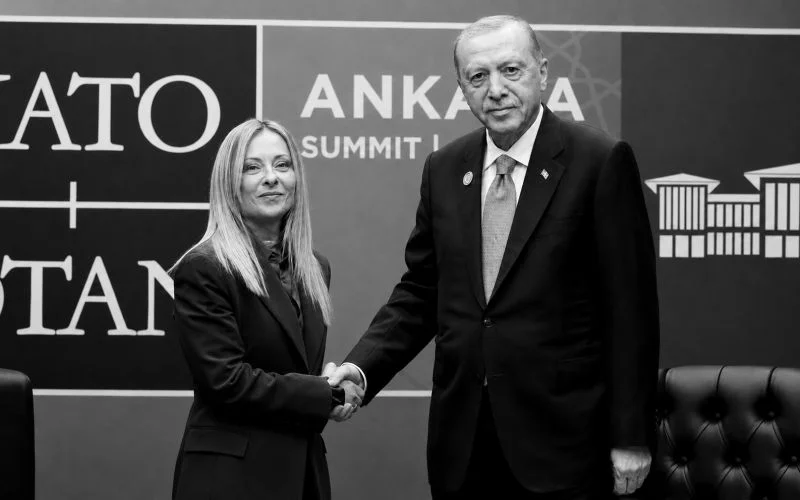
In July 2026, immediately after the NATO Summit in Ankara, Italy is being measured by its allies through two different lenses. The first reveals a country with defence companies already embedded in Europe’s most important industrial programmes and in the procurement systems of major allied powers. The second shows a government still having to demonstrate that national expenditure can rise with the same speed as the order books of Leonardo and Fincantieri. The resulting image is not that of a weak ally, but of an industrially indispensable country whose strategic weight remains partly conditional on the durability and composition of its spending.

The formal benchmark was established on 25 June 2025, when NATO leaders meeting in The Hague committed to investing 5% of GDP annually by 2035: at least 3.5% for core defence requirements and up to 1.5% for infrastructure, resilience, innovation and the defence industrial base. At Ankara on 8 July 2026, the Alliance moved from percentages to production, announcing more than $50 billion in new procurement and renewed commitments to expand manufacturing capacity. In this allied environment, industrial scale, delivery times and cross-border production are becoming as politically significant as the traditional headline figure for military expenditure.
Italy arrived at the summit declaring that defence and security investment had reached 2.8% of GDP, an increase of 0.71 percentage points from the previous year. Yet NATO’s own July 2026 tables place Italian core defence expenditure at 2.10% of GDP, compared with an average of 2.53% for European allies and Canada. The difference is not necessarily an accounting contradiction: the broader 2.8% figure includes security-related expenditure permitted under the new NATO framework, while the lower figure identifies the resources directed more specifically towards armed forces and military capabilities. For officials and analysts across the Alliance, however, the distinction matters. It separates the political presentation of security spending from the budget that generates deployable forces, ammunition stocks, maintenance capacity and operational readiness.
The comparison has become more demanding because the rest of Europe is moving rapidly. SIPRI estimates that European military expenditure increased by 14% in 2025 to $864 billion. The 29 European NATO members spent a combined $559 billion, with 22 of them reaching at least 2% of GDP under SIPRI’s methodology. NATO’s latest figures show European allies and Canada increasing core defence expenditure by more than 19% in 2025, adding approximately $139 billion in nominal terms. Italy is therefore no longer being compared with the hesitant Europe of the previous decade, but with a continent where Germany, Poland, the Baltic states and several northern allies are translating threat perception into accelerated procurement.
Against that budgetary background, Italy’s industrial profile appears considerably stronger. Leonardo ended 2025 with €23.8 billion in new orders, revenues of €19.5 billion and a backlog exceeding €46 billion, equivalent to roughly 2.4 years of production. These figures place the company not at the margins of European rearmament but inside its technological core, particularly in electronics, helicopters, aircraft, cyber systems and sensors. Its 50–50 joint venture with Germany’s Rheinmetall has already received an initial contract for 21 armoured combat vehicles for the Italian Army. In German industrial terms, Italy is consequently visible less as a customer than as a co-designer of a possible European land-systems hub.
Fincantieri creates a similar perception in the naval domain. By March 2026, the group reported a €42.7 billion backlog, 94 vessels on order and deliveries extending into the next decade. Its American subsidiary has secured work from the US Navy, including the first contract connected with the Landing Ship Medium programme, while its cooperation with France’s Naval Group through Naviris places Italian shipbuilding inside attempts to consolidate Europe’s fragmented naval sector. For American naval planners, French industrial partners and other allied customers, these relationships make Italy a source of production capacity, engineering competence and maritime technology rather than simply a Mediterranean buyer of foreign systems.
The tension lies in the relationship between this industrial reach and the structure of national expenditure. NATO estimates that 57.1% of Italy’s core defence budget in 2026 will be absorbed by personnel, while 24.45% will go to major equipment and related research and development. Italy remains above NATO’s equipment benchmark, but its budget still carries the weight of an established military organisation whose operating structure competes with procurement, readiness and technological renewal. In allied defence ministries, the question is therefore not whether Italy possesses valuable companies. It is whether the state can provide those companies and its armed forces with sufficiently predictable demand to support production lines, inventories and long-term capability planning.
This distinction also matters to investors. The European defence market is shifting from episodic national contracts towards longer production runs, joint orders and multinational supply chains. The European Defence Agency calculated that EU defence expenditure reached €343 billion in 2024, with defence investment exceeding €100 billion for the first time; it projected total expenditure of €381 billion and investment close to €130 billion for 2025. In that market, Leonardo and Fincantieri offer exposure to rising allied demand, but Italy’s sovereign credibility is judged separately from the commercial prospects of its companies. A successful Italian contractor can strengthen NATO capabilities even when questions remain about Rome’s own fiscal trajectory.
The Italy visible from allied capitals is therefore neither a free rider nor an undisputed strategic leader. It is a country whose factories, shipyards and technologies are already treated as first-tier assets, while its national commitment is examined through definitions, annual increments and the distance between 2.10%, 2.8% and the future 3.5% core target. Across NATO procurement rooms, the Italian name is increasingly found on radars, aircraft, armoured vehicles and warships; beside it, partners are still checking how firmly the corresponding budget line has been drawn.