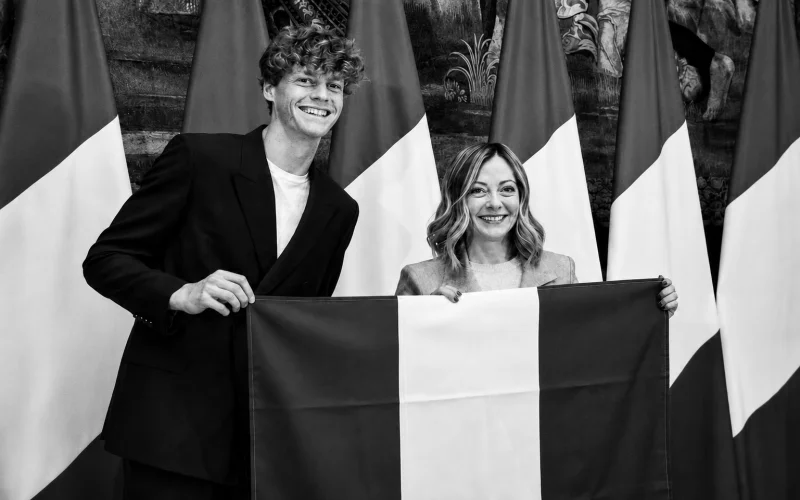
In July 2026, parts of the Western media are beginning to describe an Italy that looks different from the country traditionally reduced to beauty, creativity, food and cultural inheritance. The change is not the result of a single government campaign or a coordinated nation-branding strategy. It is emerging through a coincidence of highly visible performances: Jannik Sinner’s command of world tennis, Kimi Antonelli’s rise in Formula 1, Marco Bezzecchi’s success on an Italian Aprilia and the unusual continuity of Giorgia Meloni’s government. Together, these stories make visible an Italy associated not only with talent, but with control, preparation and endurance.

The clearest example comes from London. Sinner’s second consecutive Wimbledon title, secured on 12 July against Alexander Zverev, gave the British sports press a particularly powerful image: an Italian athlete absorbing pressure, adjusting his game and recovering from the loss of the opening set without theatrical collapse. The Guardian emphasised resilience, tactical clarity and mental strength; American coverage by the Associated Press presented the victory as the completion of a rapid return from disappointment at Roland Garros. With five Grand Slam titles at the age of 24, Sinner is no longer treated merely as a successful Italian sportsman. He has become an internationally legible symbol of methodical excellence.
That distinction matters because Western stereotypes of Italy have often admired individual brilliance while doubting collective reliability. The Italian genius was traditionally imagined as intuitive, creative and occasionally chaotic. Sinner reverses that sequence. His public image is built around repetition, discipline and emotional economy. In the foreign reading, the quality appears Italian without conforming to the familiar caricature of Italian performance. The athlete therefore expands the country’s reputational vocabulary: Italy can still produce style, but it can also produce composure.
Antonelli creates a similar effect in a different industrial environment. After nine Formula 1 rounds, the 19-year-old Mercedes driver remains at the top of the championship, despite a mechanical failure at Silverstone that reduced his advantage over George Russell to 25 points. British motorsport coverage sees an extraordinarily young Italian operating successfully inside one of the most technologically demanding systems in global sport. His case does not directly advertise Italian manufacturing, since Mercedes is a German-owned team based in Britain. It communicates something narrower but still valuable: Italy can produce technical talent capable of thriving within advanced international organisations.
Bezzecchi’s victory at Mugello offers a more direct connection between athlete, machinery and national industry. On 31 May, he won the Italian Grand Prix on an Aprilia, leading a one-two finish for the manufacturer from Noale and ending Ducati’s four-year winning sequence on the Tuscan circuit. Spanish and German-language motorsport coverage treated the result not simply as a home victory, but as evidence that Aprilia had become a serious technological competitor in a championship long dominated by another Italian engineering power. Here the country brand is not carried by personality alone. It is embedded in aerodynamics, materials, data analysis, production knowledge and corporate execution.
The political component is more complex. Meloni was sworn in on 22 October 2022 and is approaching a postwar record for uninterrupted service as Italian prime minister. In parts of the British financial press, the original anxiety surrounding her arrival has been replaced by a different question: whether political longevity can be converted into economic performance. The Financial Times has described a government that delivered continuity and fiscal discipline but has not yet produced convincing growth. Even the parliamentary defeat suffered by the governing coalition in mid-July, when a proposed electoral amendment was rejected by one vote, was covered less as the beginning of another immediate Italian government crisis than as a test of internal coalition control. That change in expectation is itself reputationally significant. Italian stability is no longer automatically treated as an impossibility, although it is not regarded as irreversible.
The combined effect helps explain Italy’s resilience in the Global Soft Power Index 2026. Brand Finance places the country ninth among all 193 United Nations member states, using research involving more than 150,000 respondents in over 100 markets. At a time when international sentiment towards many leading countries has weakened, Italy remains supported by exceptional recognition in culture, heritage, lifestyle and products. The current sporting and political cycle adds a more contemporary layer: performance under pressure, institutional continuity and technological competitiveness. It does not replace the traditional image of Italy; it makes that image less dependent on the past.
Western investors are likely to apply a stricter test. EY’s 2026 European attractiveness research, based on 500 senior international business decision-makers, treats reputation and investor confidence as part of location attractiveness, but also identifies energy costs and the operating environment as immediate competitive concerns. The OECD’s latest survey describes the Italian economy as resilient while warning that high public debt, population ageing and international competition continue to weigh on medium-term growth. The European Commission similarly points to weak productivity and increasing debt-servicing pressures. In this business reading, Sinner can open a door, Antonelli can modernise an image and Meloni can reduce the perception of political unpredictability, but none can substitute for administrative efficiency, energy competitiveness or credible fiscal management.
This is the limit and the strength of Italy’s new winning narrative. It is credible because it is not entirely manufactured: the trophies, championship positions, industrial results and years of government continuity are measurable. Yet it remains vulnerable because much of its visibility is concentrated in a small number of exceptional individuals. The country appears more disciplined when Sinner serves, more technologically ambitious when an Italian rider wins on an Italian motorcycle and more politically predictable when the same government survives another season. The Western lens is recording the change, but it still separates the brilliance of the protagonists from the reliability of the system.
For decades, the familiar foreign image of Italy was a Ferrari driven beautifully through institutional disorder. In the summer of 2026, the more interesting image is quieter: a tennis player who does not lose his balance, a teenage driver reading a complex race, an Italian motorcycle executing a precise overtake and a government whose duration has ceased to be the most surprising fact about it.