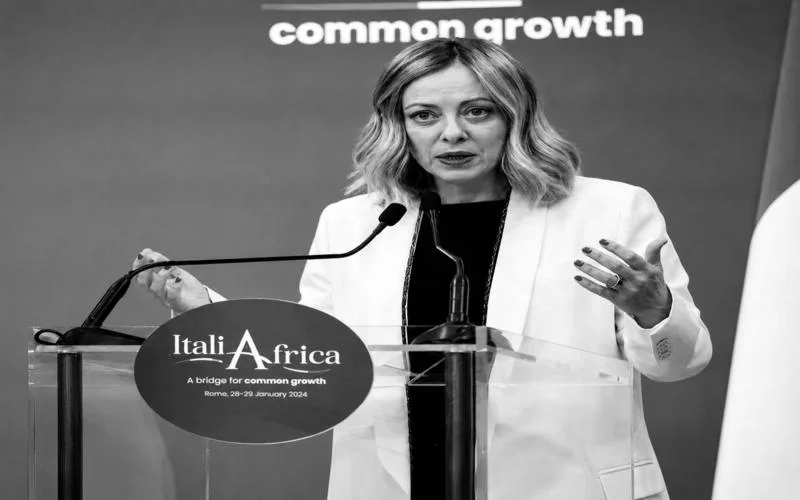
On 29 January 2024, at the Italy-Africa Summit in Rome, the Mattei Plan ceases to be only a political formula and becomes the public name of Italy’s new African strategy. The official presentation matters not only because of what Rome says it wants to do in Africa, but because of where the initiative is observed from. Seen through a French lens, the Italian move is not a simple development programme. It is an attempt to place Italy inside a strategic space where France has long considered itself a central European actor.
The Italian government presents the plan as a platform for cooperation with African countries, built around energy, agriculture, water, health, education and training. Giorgia Meloni describes it as a non-predatory partnership, opposed both to paternalism and to old extractive habits. The figure chosen to name it, Enrico Mattei, is not neutral. For Italy, Mattei evokes energy independence, state capitalism, industrial ambition and a relationship with producer countries that claims to be more balanced than the colonial model. For French observers, that symbolism inevitably touches a more delicate point: the crisis of the traditional European presence in Africa, and especially the weakening of French influence in parts of the continent.
The numbers give the Roman summit political weight. The plan begins with an initial envelope of more than €5.5 billion, including around €3 billion from the Italian Climate Fund and roughly €2.5 billion from development cooperation resources. The summit itself is held at the level of heads of state and government, a step above previous Italy-Africa meetings, and brings to Rome a large African and European diplomatic presence. This is not only protocol. It is the image Italy wants to project: a country that no longer limits itself to reacting to Mediterranean crises, but claims to organise a European conversation with Africa from Rome.
From parts of the French debate, this Italian image is read with particular attention because it arrives at an awkward moment for Paris. France’s African policy is under pressure from military withdrawals, political rejection in parts of the Sahel and a broader contest over legitimacy. In that context, Italy’s insistence on “equal partnership” is more than a slogan. It is also a competitive language. It allows Rome to present itself as a European actor less burdened, at least in perception, by the history that complicates the French position in many African societies.
That does not mean French observers are likely to accept the Italian narrative without reservation. The Mattei Plan also links development to migration control, and this connection is central to its political logic. Rome argues that creating economic conditions in African countries can give people the “right not to migrate”. In the French institutional and media lens, this formula is intelligible because Paris also knows the political pressure produced by migration. But it can also sound like a European attempt to move the management of migration further south, dressing border control in the language of development.
This ambiguity is what makes the Italian case interesting. Italy appears neither as a purely humanitarian actor nor as a traditional great power. It appears as a medium-sized European country trying to convert geography into influence. The Mediterranean is not described as a frontier to be defended only by police and coast guards, but as a strategic corridor where energy, demography, security and diplomacy meet. For France, which has long treated the Mediterranean and Africa as central theatres of foreign policy, this Italian repositioning is impossible to ignore.
Energy is the clearest example. Since Europe began reducing its dependence on Russian gas, Italy has sought to strengthen routes from the south, with Algeria, Libya and other African partners becoming more important to the Italian energy map. In the French reading, the Mattei Plan therefore cannot be separated from ENI, infrastructure, gas, renewables and the ambition to make Italy an energy hub between Africa and Europe. This gives the Italian initiative an industrial dimension that goes beyond aid. It suggests that Rome wants to turn African cooperation into a pillar of national competitiveness and European relevance.
A second example concerns institutional communication. By choosing Palazzo Madama and by framing the summit as the first major international appointment of Italy’s G7 presidency, Rome turns an African policy initiative into a statement about Italy’s place in the West. The message is that Italy can bring Africa to the centre of the G7 agenda not only as a migration problem, but as a field of energy security, food systems, training, infrastructure and geopolitical balance. From the French side, this is precisely where the initiative becomes reputational. Italy is not merely asking to participate in European Africa policy; it is trying to define part of its vocabulary.
Yet the same French lens also reveals the fragility of the Italian image. A plan presented as equal partnership must prove that African governments are not simply being invited to endorse European priorities. The African Union’s call for concrete commitments and genuine consultation shows that the symbolic success of the summit is not enough. The more Italy insists that it offers an alternative to paternalism, the more it will be judged on implementation, financing, continuity and the real involvement of African partners. For a French public accustomed to seeing European ambitions in Africa contested, this is a familiar test.
The idea of Italy that emerges from this moment is therefore sharper than the official language of the summit. Italy appears as a country seeking strategic authorship: not only a southern border of Europe, not only a recipient of migration pressure, not only a secondary partner in French or German-led frameworks, but a state attempting to write its own African policy. The Mattei Plan is the instrument; the broader claim is that Italy can act as a bridge between Europe and Africa without merely repeating older European patterns.
The French mirror makes this claim both stronger and more demanding. It strengthens it because France’s own difficulties in Africa create space for another European voice. It makes it more demanding because any Italian promise of a different relationship will be measured against the same suspicion that now surrounds many external actors on the continent. In Rome, on 29 January 2024, Italy is not yet proving that it has built a new model. It is showing that it wants to be seen as capable of one.
That is the reputational meaning of the Mattei Plan at its official presentation. Italy is using Africa to redefine its own international posture. From the French perspective, this is not a marginal Italian initiative. It is a test of whether Rome can transform Mediterranean exposure into diplomatic agency, energy vulnerability into strategic opportunity, and a migration emergency into a broader claim of influence. The outcome remains uncertain, but the image is already visible: Italy is trying to enter a space where France has long been accustomed to looking at others from the centre.