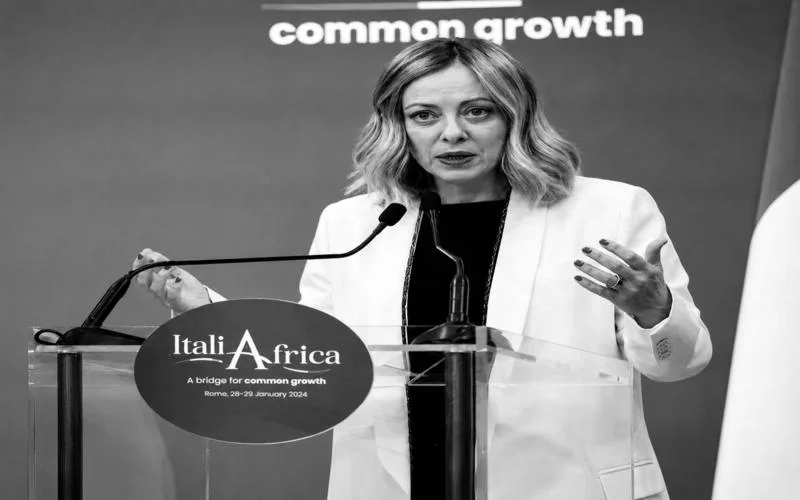
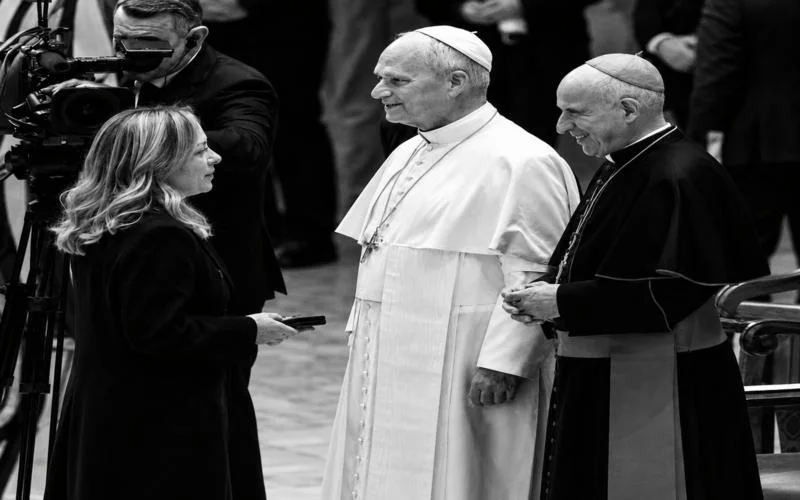
On 13 April 2026, Italy entered the American argument over Donald Trump and Pope Leo XIV through a word that was unusually direct for Giorgia Meloni: “unacceptable.” The Italian prime minister’s response to Trump’s attack on the Pope did not simply defend a religious figure. It placed Italy inside a conflict that, for the American public, was no longer only about Iran, immigration or presidential style. It was about whether conservative politics could claim Christian legitimacy while attacking the head of the Catholic Church. Reuters reported from Rome that Meloni condemned Trump’s criticism of Pope Leo after the pontiff had spoken against the Middle East war, saying it was “right and normal” for the Pope to call for peace and condemn every form of war.
The official trigger had come the previous night. Trump, writing on Truth Social late on 12 April, called Pope Leo “WEAK on Crime” and “terrible for Foreign Policy,” after the pontiff had criticized the U.S.-Israeli war with Iran and aspects of the Trump administration’s immigration agenda. CBS News, in coverage aimed at a broad American audience, presented the dispute as an escalation between the president and the first U.S.-born Pope, one in which Trump accused Leo of acting like a politician rather than a spiritual leader.
That American context matters. Pope Leo is not perceived in the United States as a distant European cleric. He is American-born, speaks directly into U.S. moral and political divisions, and has become a visible critic of Trump’s war and immigration policies. Time, writing for a general American political readership, framed Leo as an increasingly outspoken critic of the U.S.-Israeli war with Iran and reported that Trump told him to “get his act together” and stop “catering to the Radical Left.”
For Italy, the episode created a different kind of exposure. Meloni had often been read in parts of the American conservative debate as one of Europe’s most compatible leaders with Trump: nationalist, culturally conservative, combative toward the left and rhetorically close to the politics of identity. Her defense of the Pope therefore complicated a simple American picture. Italy could no longer be reduced to the European country led by Trump’s ideological ally. It appeared instead as a conservative country with a Catholic limit.
That limit is not merely theological. It is institutional, diplomatic and cultural. Italy is the state surrounding the Vatican, the country in which the Pope is not only a global religious leader but a daily presence in national public life. When Trump attacks Pope Leo, Meloni cannot respond as if the target were just another critic of the White House. To remain silent would risk making Italy look politically subordinated to Trump at the very point where Rome’s symbolic geography demands autonomy.
This is why the American public reading of Meloni’s defense is more interesting than a simple story of disagreement. From one angle, her response makes her appear less dependent on Trump than her reputation in conservative American circles might suggest. From another, it reveals a tension inside the transatlantic right: the language of Christian civilization, often used by nationalist politics, becomes harder to control when the Pope himself challenges the morality of war.
The numbers enlarge the symbolism. Straits Times, using Reuters reporting, described Trump’s attack as an unusual direct assault on the leader of the Catholic Church, a global institution of around 1.4 billion members. That scale changes the political meaning of the quarrel. Trump was not only insulting a foreign dignitary. He was confronting an authority whose voice reaches into American Catholic communities, Italian public life and the broader moral vocabulary of the West.
The first concrete example is political. For American conservatives, Meloni’s usefulness has often been that she seemed to prove that nationalist conservatism could govern inside Europe without immediately collapsing into chaos or isolation. Her rebuke of Trump shows a boundary. She can share parts of the American right’s cultural language, but she cannot easily follow Trump when his attack touches the Pope. That distinction may strengthen her image among Americans who value institutional seriousness, while irritating those who interpret criticism of Trump as disloyalty.
The second example is diplomatic. Italy’s relationship with the United States is strategic, but its relationship with the Vatican is unique. Meloni’s statement therefore performs a balancing act visible to Washington: Rome can stay Atlantic, conservative and close to the United States while still defending the Pope’s right to speak about peace. In American perception, that balance makes Italy neither anti-Trump nor fully trumpian. It makes Italy a country where Catholic authority still has enough public weight to interrupt partisan alignment.
The Pope’s own response sharpened this reading. Al Jazeera, drawing on Reuters, reported that Leo said he had “no fear” of the Trump administration and that the Vatican’s appeals for peace were rooted in the Gospel. That answer turned the dispute from a social-media clash into a confrontation between political power and moral speech.
Seen from this American angle, Meloni’s defense of Pope Leo does not transform Italy into an opponent of Trump. It reveals something more precise: Italy can be politically close to the American right, but it is not culturally absorbed by it. The country that appears in this episode is conservative, Atlantic and Catholic at once. Its prime minister may speak a language familiar to Washington’s right, but when Trump’s politics collides with the Pope, Rome cannot pretend that the Vatican is just another foreign voice.