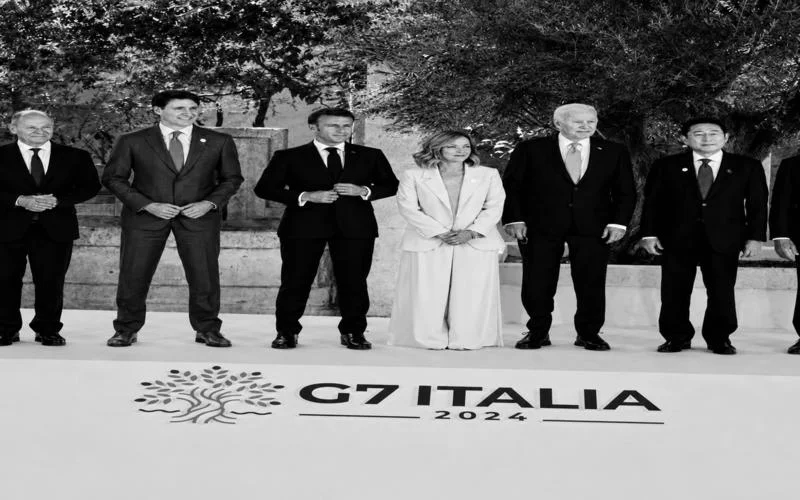
In the American reading of the G7 summit in Apulia, Italy is not simply the landscape in which Western leaders have gathered for three days. It is the stage on which a more demanding question is being tested: whether Rome can turn visibility into diplomatic weight, and whether the Italian presidency can translate hospitality, agenda-setting and Atlantic alignment into a recognizable form of international reliability.
The summit at Borgo Egnazia, held from 13 to 15 June under the Italian G7 presidency, brings together an unusually dense agenda: Ukraine, Gaza, Africa, migration, economic security, China and artificial intelligence. For American institutions and much of the U.S. policy debate, however, the Italian event is being read first through the lens of strategic coordination. The White House’s own account presents the Apulia summit as a place where G7 leaders are “standing united” on Ukraine, Russia, economic security, critical technologies and development finance. In that formulation, Italy appears less as a ceremonial host than as the temporary operating room of the Western coalition.
The most concrete measure is the agreement to unlock $50 billion in new financing for Ukraine by using the proceeds of immobilized Russian sovereign assets. That figure gives the summit its hard diplomatic substance. It also places Italy inside a negotiation that matters deeply to Washington: how to maintain support for Kyiv while making Moscow pay a rising cost and while managing European legal and financial caution. Politico described the agreement as the result of months of talks among the United States and European allies, built around interest from roughly $300 billion in frozen Russian assets. The American view of the summit therefore does not isolate Italy from the mechanism; it measures Italy by its capacity to host a convergence that Washington had been seeking.
This is why Meloni’s meeting with President Biden has a meaning that exceeds protocol. The White House readout says Biden commended Italy’s steadfast support for Ukraine and that the two leaders discussed security, economic and regional issues, including the $50 billion package, economic coercion, two-way trade and investment, and the need for a ceasefire and hostage deal in Gaza. From Washington’s institutional language, Italy emerges as a partner whose usefulness is not ideological but functional: a government able to sit inside the Atlantic framework, sustain Ukraine, and keep economic security on the agenda.
That image matters because it contrasts with one of the older American reflexes about Italy: the country admired culturally, but treated politically as unstable, decorative or secondary. In Apulia, the visible Italy is different. It is not only providing the scenery; it is arranging the table on which Ukraine financing, China-related industrial risks, supply chains, migration and artificial intelligence are discussed together. The distinction is important. A host receives leaders. A diplomatic platform shapes the sequence in which problems become governable.
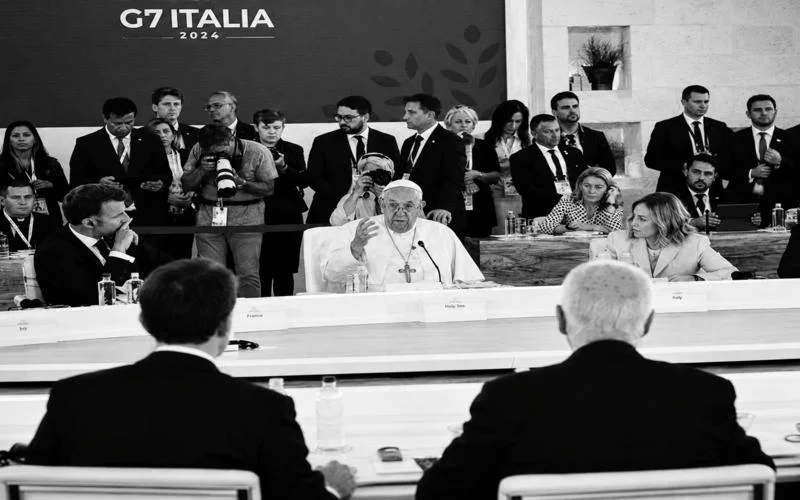
The American lens is also attentive to the summit’s technological chapter. The decision to bring Pope Francis into the G7 discussion on artificial intelligence gives the Italian presidency a distinctive signature. AP had already framed the Pope’s participation as unprecedented, noting that he would be the first pontiff to attend a G7 summit and would join the session on artificial intelligence. In U.S. coverage, this is not merely a Vatican anecdote. It places Italy at the intersection of political regulation, ethical language and technological power at a time when AI is becoming a central field of transatlantic competition.
For American observers, the importance of that move lies in the contrast between where AI is developed and where its political legitimacy is discussed. The United States remains the central industrial and technological actor in the AI race; Europe is trying to define rules; Italy, through the G7 presidency, is attempting to give the issue a wider moral and geopolitical frame. The result is not that Italy becomes an AI power. It is that Italy appears capable of placing itself in the conversation about the governance of technologies it does not dominate industrially. That is a subtler but still significant form of diplomatic positioning.
The same logic applies to Africa and infrastructure. The Italian presidency has connected its Africa-Mediterranean focus with food security, energy and development finance. In the bilateral meeting, the Italian and American sides also referred to cooperation between the Mattei Plan and the Partnership for Global Infrastructure and Investment, including the Lobito Corridor. For U.S. policy circles, this makes Italy relevant not as a Mediterranean exception, but as a possible bridge between European priorities, African development needs and Western competition with Chinese influence.
Here the image of Italy becomes more ambitious, but also more fragile. The ambition is clear: Rome wants to be read as a connector between the Atlantic alliance, the Mediterranean, Africa and the wider contest over economic security. The fragility is equally clear: American recognition depends less on the elegance of the summit than on whether Italian initiatives can produce continuity after the cameras leave Puglia. A summit can generate visibility in forty-eight hours; credibility requires the repetition of delivery.
There are also limits in the American framing. U.S. coverage has not looked at the Italian G7 only through the lens of diplomatic performance. AP also reported tensions over language on abortion in the final declaration, an issue that briefly shifted attention from coalition unity to the cultural politics of the Italian government. That episode complicates the image of Italy as a neutral platform. It suggests that even when Rome organizes a global summit with discipline, domestic political identity can still enter the diplomatic text and become visible abroad.
The strongest American reading of Apulia is therefore not one of simple praise. Italy appears as a reliable Western partner, but not as a frictionless one; as a capable organizer, but not yet necessarily as a durable agenda-setter; as a country able to give form to Atlantic priorities, but still tested by the distance between symbolic leadership and operational follow-through.
Seen from Washington, the G7 in Puglia gives Italy something more valuable than ceremonial attention. It gives it a temporary role as a place where Western problems are translated into collective positions. Ukraine financing, AI governance, economic security and Africa are not minor files; they are central to the way the United States now reads the international order. The Italian presidency has placed itself inside that reading.
The idea of Italy that emerges is therefore precise: not the old Italy of charming instability, nor a sudden great-power substitute for France or Germany, but a country trying to convert political stability at home into usability abroad. In the American mirror, the question is not whether Italy hosted the G7 well. It is whether Apulia has shown that Italy can be more than the venue of Western diplomacy that it can be one of the places where Western diplomacy is made.