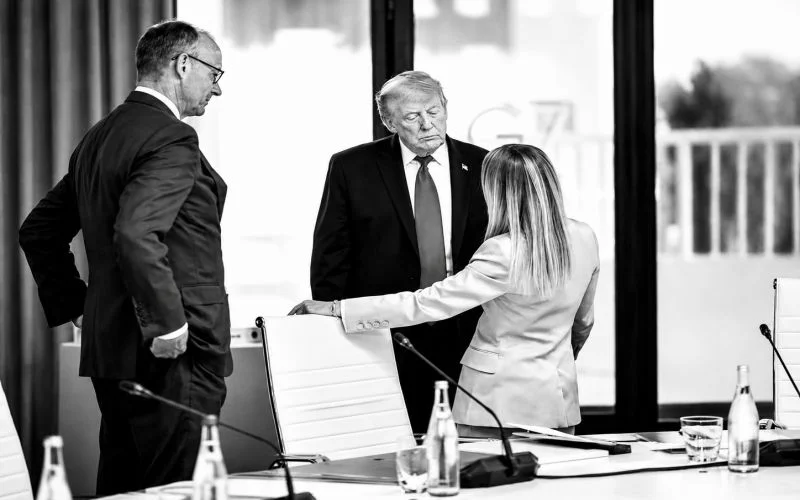
The public clash between Donald Trump and Giorgia Meloni did not begin as a grand diplomatic rupture. It began with a photograph, or more precisely with the claim that a photograph had been requested in humiliating terms. Yet in the American coverage of the episode, the issue quickly moved beyond protocol, vanity or personal offense. It became a test of what Italy’s closeness to Trump had actually bought: influence, access, or a new kind of vulnerability.
The formal stage was the G7 summit in Évian-les-Bains, officially scheduled by the French presidency from June 15 to 17, 2026. It was meant to place the leading industrial democracies around questions of security, supply chains, economic resilience and global instability. Instead, one of the images that travelled through American media was narrower and more revealing: the Italian prime minister standing not simply beside the American president, but inside the unpredictable theatre of his personal politics.
ABC News, writing for a broad American audience, framed the dispute as a feud over Trump’s claim that Meloni had “begged” him for a photo at the G7. But the article’s significance lay less in the quote itself than in the way it reported Meloni’s reply: her insistence that her popularity depended on defending Italy’s national interest, and her sentence that neither she nor Italy ever beg. In that formulation, the American reader was not only being shown an offended leader. The reader was being shown an Italian head of government trying to move the subject from personal embarrassment to national status.
Axios, a publication closely read in Washington political and institutional circles, placed the quarrel in a more strategic frame. Its “why it matters” was not Italian domestic drama. It was the growing willingness of close allies to split with Trump, even as he continued to praise adversaries. In that Washington lens, Italy appeared as a case study in the limits of personal diplomacy with an American president who treats alliance management as a public hierarchy of loyalty, gratitude and punishment.
That is what makes the episode reputationally important for Italy. Meloni had often been described in American conservative and business circles as one of the European leaders most capable of speaking Trump’s language without breaking with Brussels. The earlier promise was that ideological familiarity could become diplomatic utility. The April 2025 United States–Italy joint leaders’ statement had presented the relationship as a strategic alliance across security, economic and technological issues, including defense supply chains, AI and cloud investment, LNG, shipbuilding, space cooperation and the India–Middle East–Europe corridor. In that document, Italy was not a supplicant. It was described as a platform: Mediterranean, industrial, technological and geopolitical.
The photo dispute damaged precisely that carefully constructed image. In parts of the American reading, Italy no longer appeared only as the European conservative bridge to Washington. It appeared as a country exposed to the reputational cost of having made that bridge too personal. The problem was not sympathy with Trump’s political world in itself. The problem was that proximity to him could be reinterpreted, by Trump himself, as dependency.
This matters because the Italy–United States relationship is not symbolic. According to U.S. Census Bureau trade data, in 2025 the United States exported about $43.1 billion in goods to Italy and imported about $74.4 billion from Italy. That is not a ceremonial relationship; it is an industrial and commercial corridor involving machinery, pharmaceuticals, luxury manufacturing, aerospace, energy and technology. When a political relationship is personalized, the reputational noise can reach beyond diplomacy into the mental map used by investors, procurement officers, defense contractors and corporate risk managers.
The security dimension is even more delicate. Trump’s criticism also touched Italy’s refusal to make airstrips available in the context of the U.S. war with Iran, a point reported by ABC News and Axios as part of the same deterioration. Here the American lens shifts from insult to alliance management. Italy is read not only as a friendly government, but as a sovereign European ally that hosts and cooperates with U.S. military structures while still retaining legal and political boundaries. NATO’s 2025 estimates put Italy’s defense expenditure at about 2.01 percent of GDP, up from 1.13 percent in 2014. That figure matters in Washington because burden-sharing has become one of the most visible metrics through which allies are judged.
The Wall Street Journal, addressing a business and policy readership, offered another layer: Meloni’s governing strength has partly rested on a combative style able to turn personal affront into political definition. In that reading, her answer to Trump was consistent with a broader image of discipline, stability and controlled confrontation. But for Italy, the interesting point is not Meloni’s temperament. It is that American business media could read the incident as evidence that Italian stability now includes a capacity to resist humiliation from a political ally.
The foreign image produced by the episode is therefore ambivalent. Italy appears more assertive than in older stereotypes of dependency on Washington. It also appears more exposed than it may have intended, because the line between privileged access and reputational subordination has become visible. The same relationship that once allowed Meloni to be presented as a useful interpreter between Trump and Europe now forces her to show that Italy’s Atlantic position is institutional, not personal.
For American observers, the quarrel is not mainly about whether a photograph was requested. It is about whether Italy can remain close to the United States without being absorbed into the performance style of one American president. The scene at Évian leaves a sharper image than the official family photo: an Italian leader standing inside the Atlantic alliance, close enough to be targeted by Trump’s language, and far enough away to answer in the name of the state rather than in the language of friendship.