In late 2024, a bank transaction in Frankfurt is becoming a test of European finance not because it is technically unusual, but because the buyer is Italian and the target is a German institution embedded in the country’s industrial memory. The Commerzbank case places Germany before an uncomfortable question: whether banking union is meant to operate only when consolidation remains abstract, or also when control of a familiar national lender may shift across the Alps.
The formal starting point came on 11 September 2024, when UniCredit announced that it had acquired around 9 per cent of Commerzbank’s share capital. The most politically charged part of the operation was not hidden in the market: 4.49 per cent came from an accelerated bookbuilding sale conducted on behalf of the Federal Republic of Germany, while the remainder had been bought through market activity. Germany’s own Finance Agency said the block amounted to roughly 53.1 million shares and about €702 million, allocated to UniCredit after it clearly outbid the other offers. That official date matters because it fixes the origin of the affair not in Italian ambition alone, but in a German decision to reduce a crisis-era holding.
In financial terms, UniCredit presented the move as disciplined and strategic. The Milan-based group said the investment was consistent with its parameters and that it would engage with Commerzbank to explore opportunities for value creation. Commerzbank’s first public response was cautious rather than openly hostile: its management and supervisory boards said they had taken note of the announcement and would act in the interest of shareholders, employees and clients. In the language of corporate communication, this was still a shareholder event. In parts of the German political and labour debate, however, it quickly became something wider: a possible transfer of influence over a bank seen as part of the country’s economic infrastructure.
That shift is what makes the episode important for the image of Italy. German debates about Italy often begin with debt, fiscal discipline and institutional reliability. Here the frame is inverted. The Italian actor is not asking for flexibility, protection or indulgence. It is buying. More precisely, it is buying into a German bank that still carries the memory of state support after the financial crisis and that retains symbolic value for Frankfurt, corporate lending and the German Mittelstand. The Italy that appears through this German lens is therefore not the fragile debtor of familiar eurozone narratives, but a bank-led, capital-deploying country capable of forcing a conversation inside the German financial system.
Markets initially read the event through a different grammar from politics. Commerzbank shares jumped sharply after UniCredit’s entry, with reports pointing to a rise of about 18 per cent and a purchase price of €13.20 per share, above the previous closing price of €12.60. For investors, the Italian move suggested optionality: consolidation, a higher valuation, pressure on management, or at least a new strategic discipline around a German lender long discussed in the context of domestic banking combinations. The market signal did not say that a takeover was desirable or inevitable. It did show that an Italian bidder could be interpreted as a catalyst, not merely as an outsider.
The German institutional reaction moved in the opposite direction. After UniCredit used financial instruments to raise its potential exposure to about 21 per cent, subject to approvals, Chancellor Olaf Scholz described the move as an unfriendly attack and rejected hostile takeovers in banking. The wording was politically revealing. It did not simply question valuation or execution risk. It translated a capital-market move into a language of defence. In that framing, the Italian bank ceased to be only a shareholder and became a pressure point on German economic sovereignty.
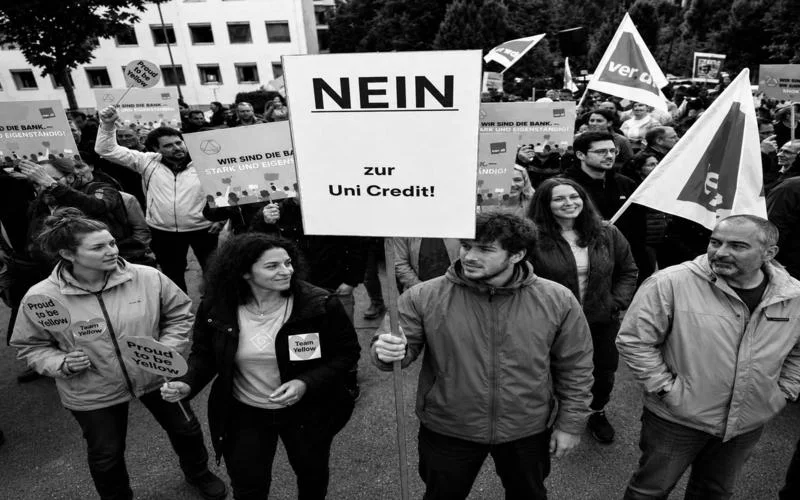
The trade union and works council response made that framing even clearer. Ver.di and Commerzbank employee representatives called on the federal government to oppose a UniCredit takeover and to support a strong, independent Commerzbank. Their concern was not an abstract debate about European banking architecture. It was grounded in jobs, governance, client relationships and the role of the bank for German companies. For business observers, this is the concrete layer beneath the political rhetoric: who controls credit channels, where decisions are made, how headquarters functions are distributed, and whether cross-border consolidation produces scale or loss of domestic influence.
Seen from this German angle, the single market is not denied; it is narrowed at the moment it becomes consequential. Brussels can encourage deeper banking integration, supervisors can assess capital and governance, and investors can reward strategic clarity. Yet the Commerzbank case shows that the emotional boundary of the national economy remains active. A French, Spanish or Italian bank may be European in regulatory language, but when it approaches a German institution with political memory, the transaction is measured against sovereignty, employment and national industrial finance. Italy’s new image here is therefore double: more assertive and more credible financially, but also more exposed to the suspicion reserved for those who cross from being a market participant to becoming a potential controller.
For an Italian company, that is a significant reputational reversal. UniCredit is not being read as a distressed group searching for shelter, but as a strategic operator able to unsettle Germany on German ground. At the same time, the resistance shows the limit of admiration. Financial strength wins attention; control triggers defence. The Italian presence becomes most visible precisely when it stops being decorative and starts altering the balance of power.
The scene in Frankfurt is therefore sharper than a normal banking story. A German state sale opened the door, an Italian bank walked through it, investors saw value, and political actors began to redraw the threshold. In the glass towers around Commerzbank, the idea of European finance is no longer a slogan about scale. It is a question of how much Europe still feels European when the buyer speaks Italian.