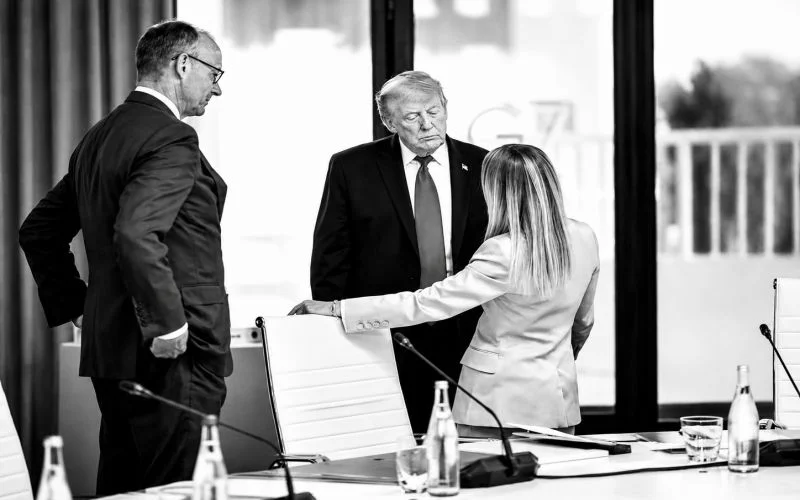
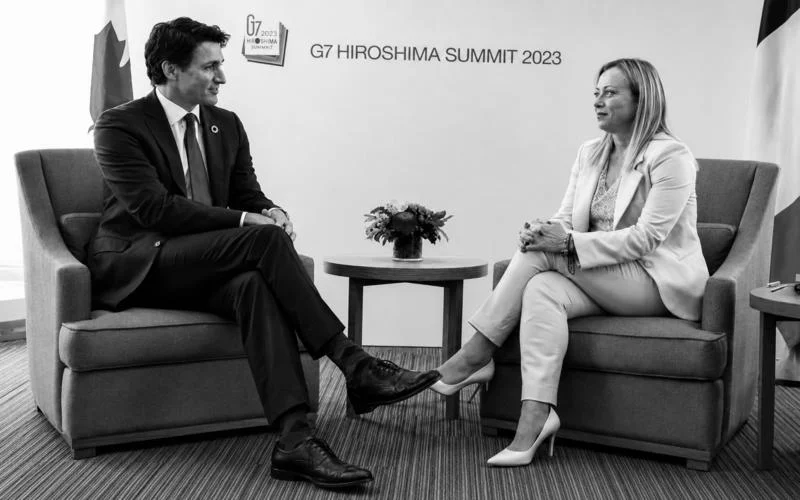
On 19 May 2023, during the G7 summit in Hiroshima, Justin Trudeau raised the issue of LGBT rights directly with Giorgia Meloni at the start of their bilateral meeting. Speaking in front of the cameras, the Canadian prime minister said that Canada was concerned about some of the positions Italy was taking, a reference to the Meloni government’s line on the registration of children of same-sex couples, especially after the case of Milan. Meloni replied that her government was acting within the framework of court decisions and was not departing from the approach of previous administrations. What in Italy was presented as a legal and administrative question entered the Canadian public sphere as something more immediate: a test of whether a G7 democracy was protecting minority families or allowing political conservatism to narrow their recognition.
That public reaction matters more than the diplomatic wording itself. Trudeau was not speaking only as one head of government to another. He was speaking in a language that many Canadians recognize as part of their national self-image: inclusion, equality, minority protection and the defence of LGBTQ people as a public value. Canada had legalized same-sex marriage nationwide in 2005, and by 2023 its federal government was openly presenting 2SLGBTQI+ equality as part of public policy, not merely as a private social question. In that environment, the Italian case was unlikely to be received as a narrow administrative dispute over municipal registers. It was received as a sign that a G7 partner might be moving in the wrong direction.
Canadian coverage reinforced that reading. Global News, carrying Canadian Press reporting, described Trudeau as having “called out” Italy’s stance on LGBTQ rights during his meeting with Meloni. That verb is important. “Called out” is not neutral diplomatic language. It belongs to the vocabulary of public accountability. It suggests that something visible, questionable and morally legible has been named in front of others. For many Canadian readers, the story was therefore not “Trudeau and Meloni exchange views.” It was “Canada challenges Italy on rights.”
This is the first point Italy had to confront in the Canadian mirror. The Canadian public did not need to master the legal details of Italian family law to understand the episode. The headline had already done the work. Italy was associated with restrictions on the recognition of same-sex parents, and Meloni was placed in the role of the conservative leader being questioned by a liberal prime minister. The emotional direction of the story was clear before the procedural explanation arrived.
Meloni’s defence was not without substance. She replied that her government was following court decisions and was not departing from previous administrations. From an Italian institutional perspective, that answer was coherent. It shifted the issue from ideology to legality, from culture war to judicial constraint, from political intention to administrative competence. In Rome, that distinction mattered. The question of parenthood in same-sex couples involved courts, municipalities, adoption rules, biological parenthood and the unresolved Italian debate over assisted reproduction and surrogacy.
But in Canadian public perception, that legal defence had a weaker emotional force than Trudeau’s concern. The Canadian audience was not primarily asking whether the Italian interior ministry had acted within the technical limits of Italian law. It was asking what happened to the families. If a child had two parents in daily life but only one was recognized on paper, the Canadian moral instinct was likely to see vulnerability before procedure. Meloni’s answer may have explained the Italian state. It did not necessarily reassure the Canadian public.
This is where the episode becomes revealing for Italy’s image. Canada did not see Italy as an authoritarian country outside the democratic family. It saw Italy as a fellow G7 democracy whose social direction had become questionable. That is a more subtle and demanding form of scrutiny. Italy remained inside the club, but it was being measured by standards that many Canadians consider already settled. For a public accustomed to treating same-sex family recognition as part of equality, the Italian hesitation looked less like constitutional caution and more like regression.
At the same time, the Canadian response was not purely objective. It simplified Italy. It compressed a complicated legal and political field into the broader category of LGBTQ rights. It gave little space to the distinction between recognizing a family socially, registering parenthood administratively and legislating on adoption or assisted reproduction. It also made Meloni appear more personally responsible for a legal situation that had roots before her government. From a more sympathetic reading of the Italian prime minister, this was the weak point of the Canadian reaction: it judged Italy through a moral shorthand that was powerful, but incomplete.
Yet public opinion often works through shorthand. The Canadian public did not encounter the issue as a legal memorandum. It encountered an image: Trudeau, in front of cameras, telling Meloni that Canada was concerned. That scene confirmed a familiar Canadian story about itself. Canada was the liberal democracy willing to speak up. Italy was the conservative democracy being reminded of a standard. Whether that was fully fair to Meloni was almost secondary to the public effect.
The first concrete consequence was reputational. Meloni had arrived at the G7 trying to project reliability: support for Ukraine, seriousness in foreign policy, continuity inside the Western alliance. The Canadian public frame pulled her toward another identity, that of a leader whose government raised doubts on civil rights. This did not erase her strategic credibility, but it complicated it. In the Canadian view, international reliability was not only about defence, budgets or diplomacy. It also included the treatment of minority families.
The second consequence was communicative. Meloni’s defence may have been legally precise, but precision travels slowly. Trudeau’s concern travelled quickly. In a public sphere shaped by short clips, headlines and value-based reactions, the side that speaks in moral language often reaches the audience first. Meloni’s position required explanation. Trudeau’s position required recognition. That difference shaped how the episode was likely absorbed by many Canadian readers and viewers.
The image of Italy that emerged in Canada was therefore not simply hostile to Meloni, but it was difficult for her. Italy appeared as a serious democracy led by a conservative prime minister who could defend herself on legal grounds, yet struggled to make that defence resonate in a country where LGBTQ family recognition had already become part of the mainstream democratic vocabulary. The Canadian public response did not necessarily prove that Italy was illiberal. It showed something more precise: when Italy’s legal conservatism is viewed from a society that treats inclusion as settled public common sense, Meloni’s strongest argument can sound less like reassurance than explanation after the fact.