The American attention surrounding Giorgia Meloni’s relationship with Donald Trump is not only a story about ideological affinity. It is a story about the way Italy is being reclassified in Washington: not as Europe’s chronic political exception, not merely as a Mediterranean ally, but as a possible interpreter between an America First presidency and a European Union that the new administration treats with suspicion. In this reading, Italy appears useful because it is inside the European system without fully sounding like Brussels. That is the source of its diplomatic value, but also of its exposure.
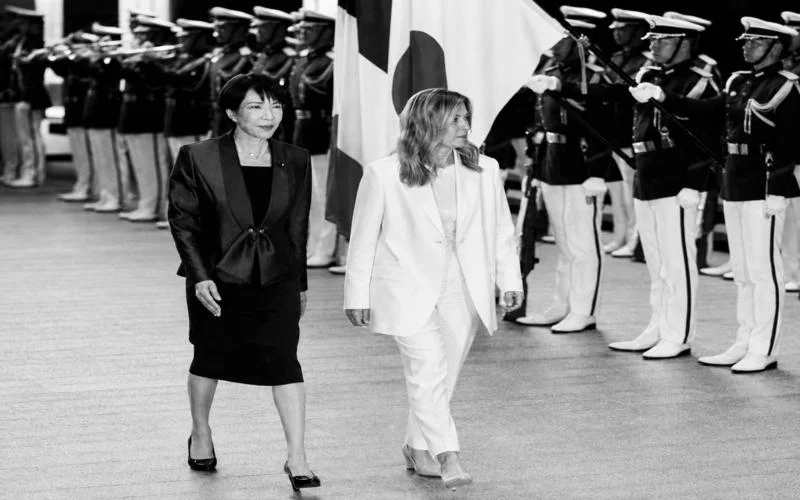
The formal turning point came on 17 April 2025, when Meloni met Trump at the White House. The meeting was not important only because she was received warmly, or because the two leaders displayed a visible political rapport. It mattered because the joint language around the visit opened the possibility of a future meeting in Italy between the United States and Europe. At that moment, the Italian capital was no longer presented simply as the seat of a bilateral ally. It became imaginable as a stage on which Washington and Brussels might speak through Rome.
From parts of the American press, the Italian role was therefore framed less as leadership in the traditional European sense than as access. Meloni was described as one of the few European leaders able to enter Trump’s political language without appearing hostile to the European framework. The distinction is essential. Washington was not discovering Italy as a strategic superpower. It was discovering Italy as a country whose prime minister could talk to Trump without triggering the immediate resistance that other European figures often produced. That gave Rome a functional importance: it could lower the temperature of transatlantic disputes, especially on trade, Ukraine and defence.
The Italian image that emerges from this American lens is unusually specific. Italy appears as a hinge country. It is Atlantic but European, conservative but institutionally integrated, politically close to Trump but not outside the EU order. The attraction lies precisely in that ambiguity. For a White House skeptical of supranational structures, Meloni’s Italy seemed to offer a more legible Europe: national, political, direct, less bureaucratic. For European capitals, however, the same feature was more delicate. A bridge is useful only if it does not become a bypass.
This ambiguity was visible in the trade dispute. By spring 2025, the United States had turned tariffs into a central instrument of pressure on its partners. For American observers, Meloni’s visit took place against a concrete economic background, not a symbolic one. The United States and Italy had $137.6 billion in two-way trade in goods and services in 2024, while U.S. imports from Italy were far larger than U.S. exports to Italy. That made Italy commercially relevant to Washington, but also vulnerable to a tariff logic that reads trade imbalances as negotiating material. Italian luxury goods, machinery, pharmaceuticals, food, automotive components and industrial equipment were not abstract categories in this debate. They were sectors whose exposure helped explain why Rome had an interest in keeping a channel open.
The second example was defence. In the American view, friendship with Trump could not be separated from burden-sharing. NATO figures for 2024 placed Italy’s defence spending at 1.49 percent of GDP, below the Alliance’s 2 percent guideline. This number complicated the image of Italy as a perfect Atlantic partner. It did not erase Meloni’s credibility in Washington, but it placed that credibility inside a transactional environment. In Trump’s language, loyalty is rarely only rhetorical. It must be visible in spending, procurement, bases, energy, technology and concessions.
This is why the American reading of Meloni as a bridge carried both admiration and doubt. The admiration concerned political fluency. Meloni could speak of the West, borders, national interest and strategic realism in terms that were immediately recognizable to Trump’s world. She could defend Ukraine without sounding like the old liberal Atlantic establishment. She could criticize European excesses without formally breaking with Brussels. She could reassure Washington that Italy remained a serious ally while reassuring Europe that Italy was not leaving the European table.
The doubt concerned scale. A personal channel can help open doors, but it cannot replace institutional power. Italy can host, translate, soften, anticipate and signal. It cannot negotiate EU trade policy on its own. It cannot determine NATO’s European burden-sharing alone. It cannot guarantee that Washington will treat Europe as a partner rather than as a field of bilateral deals. The American press often captured this tension: Meloni’s position was valuable because she could reach Trump, but risky because the same access might be read in Brussels as freelancing.
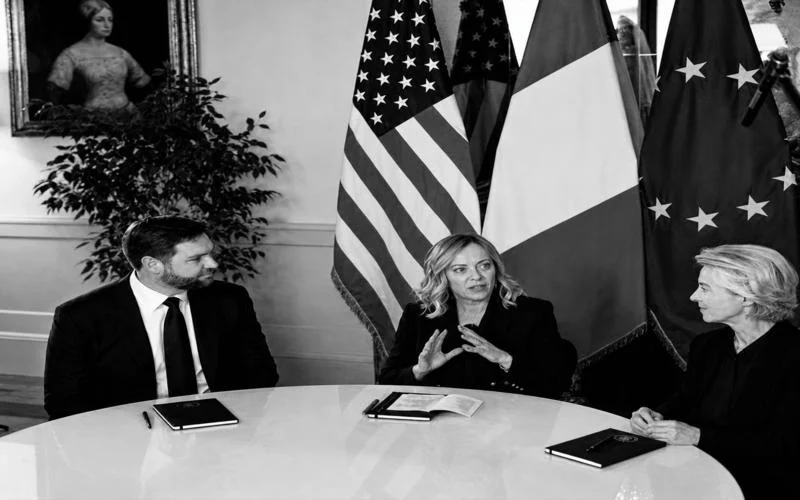
The trilateral meeting in Rome in May 2025, with JD Vance and Ursula von der Leyen around the same table, gave this role a more concrete shape. For Italy, it showed that the bridge was not only a metaphor. For American observers, it confirmed that Rome could be used as a diplomatic room where Washington and the EU could test language without immediately turning every disagreement into a public fracture. Yet the event also showed the limits of the Italian function. The bridge did not eliminate disagreement on tariffs, Ukraine or European strategic autonomy. It merely created a place where those disagreements could be managed.
Seen from the United States, then, Meloni’s Italy is not simply admired. It is used, tested and measured. The country’s reputation improves when personal access becomes institutional usefulness. It weakens when the access looks too personal, too dependent on Trump’s mood, or too distant from European discipline. The American mirror does not show Italy as the new leader of Europe. It shows a country trying to turn political proximity into diplomatic relevance.
That is a powerful but unstable image. Italy appears more central than usual because the transatlantic relationship itself has become less predictable. Rome’s advantage lies in speaking to both shores. Its risk lies in being judged by both. As long as Washington sees Meloni as a credible European interlocutor, and Brussels accepts Italy’s role as coordination rather than substitution, the bridge can raise Italy’s profile. If either side withdraws that consent, the same bridge becomes exposure: a visible structure suspended between two forces it does not control.