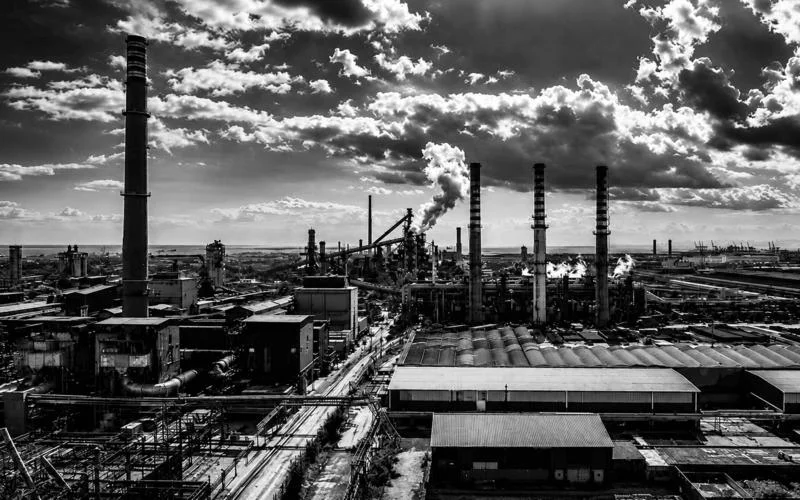
In late 2024, the former Ilva steelworks in Taranto is not merely an Italian industrial crisis observed from Germany. It appears as a concentrated European dilemma: how a country can keep a strategic steel plant alive while health, environment, energy costs, employment and public intervention all pull in different directions. The formal date that defines this phase is 20 February 2024, when Italy’s Ministry of Enterprises and Made in Italy admitted Acciaierie d’Italia to extraordinary administration and appointed Giancarlo Quaranta as commissioner, after Invitalia, the public shareholder with 38 per cent of the capital, requested immediate intervention.
The German lens matters because steel is not a marginal industry in Germany’s economic imagination. It sits at the junction of cars, machinery, construction, energy policy and industrial sovereignty. That is why German-language economic coverage of Taranto focused less on the local drama than on the scale and cost of the rescue. Merkur, in business coverage aimed at a broad German readership, described the plant as Europe’s largest steelworks, insolvent, exposed to state intervention and potentially costly not only for Italian taxpayers but for European ones. The same report underlined the ownership conflict: ArcelorMittal held 62 per cent of Acciaierie d’Italia, while the Italian state held 38 per cent, and more than 10,000 workers depended directly on the plant, with many suppliers tied to its survival.
Seen from that angle, Taranto does not produce the image of an Italy without industry. It produces a more uncomfortable image: Italy as a country still holding essential industrial assets, but unable to free them from a cycle of emergency, legal conflict, environmental damage and state rescue. The plant’s size keeps Italy inside the European industrial map; its governance keeps Italy under scrutiny. For German observers used to reading steel through competitiveness, electricity prices and decarbonisation, the Italian case becomes a warning about what happens when the industrial transition arrives before the institutional solution.
The contrast with Germany’s own debate makes the mirror sharper. In 2024, the German steel industry was being discussed through the language of green hydrogen, industrial electricity prices and climate-neutral production. The Federal Ministry for Economic Affairs and Climate Action described green steel as requiring a complete overhaul of production processes, with Germany aiming for climate-friendly steel production by 2045. Wirtschaftsvereinigung Stahl, the German steel federation, placed the sector at the centre of industrial decarbonisation: transforming steel could reduce 30 per cent of Germany’s industrial emissions, equal to about 50 to 55 million tonnes of CO₂ per year.
That is why Taranto is not read only as pollution. It is read as a failed or delayed transition problem. In Germany, steel is linked to the future of the automotive industry, mechanical engineering and construction. The German steel federation’s 2024 data show that construction accounts for 33 per cent of steel demand in Germany, automotive for 28 per cent and mechanical engineering for 13 per cent. These are not abstract figures: they explain why green steel has become a supply-chain issue, affecting product carbon footprints, industrial location decisions and investment credibility.
Taranto, by contrast, still forces the European debate back to more basic questions: whether a blast-furnace complex can remain open without unacceptable health risks; whether public money can buy time without becoming permanent dependency; whether a buyer can price environmental liabilities, labour expectations and energy needs into a credible industrial plan. For a German business reader, the site is not only a factory. It is a due-diligence problem made national.
The health and legal dimension reinforced this perception in June 2024. The Court of Justice of the European Union ruled that the operation of the Ilva steelworks must be suspended if it poses serious and significant threats to the environment and human health. The Court recalled that the plant began operating in 1965, employs about 11,000 people and covers almost 1,500 hectares, making it one of the largest steelworks in Europe. It also noted that measures to reduce its impact had existed since 2012, but that deadlines had been repeatedly extended.
From a German institutional perspective, that point is central. The problem is not only that Taranto pollutes. It is that the exception becomes a governing method. The longer emergency rules last, the more Italy appears as a country where strategic industry survives through postponement: postponement of environmental remediation, postponement of ownership clarity, postponement of a stable industrial model. The result is reputationally damaging because it suggests not indifference, but difficulty in closing decisions.
The attempt to return the plant to the market did not remove that ambiguity. On 31 July 2024, the Italian government authorised the publication of the call for expressions of interest for the acquisition of Ilva and Acciaierie d’Italia assets, with interested parties given until 20 September. The procedure placed together production continuity, decarbonisation and employment protection — exactly the three conditions that make the asset strategic and difficult at the same time.
A few weeks earlier, on 12 July 2024, the ministry announced a European Commission comfort letter on a €320 million bridge loan for Acciaierie d’Italia in extraordinary administration, with an annual interest rate of 11.6 per cent. In financial terms, this gave oxygen to the commissarial plan. In reputational terms, it also confirmed how far the case had moved from ordinary corporate management into the territory of state-backed industrial risk.
The image of Italy that emerges from this German-facing reading is therefore neither simply negative nor sentimental. It is the image of a country with industrial weight, but with unresolved industrial statecraft. Taranto shows Italy as indispensable and encumbered at the same time: too important to abandon, too damaged to normalise, too strategic to leave entirely to the market, too exposed to be solved only by decree. In the German industrial mirror, the furnaces of Taranto illuminate not only a southern Italian skyline, but the harder question of whether a European manufacturing country can still turn an old heavy-industry giant into a credible future asset before emergency becomes its permanent operating model.