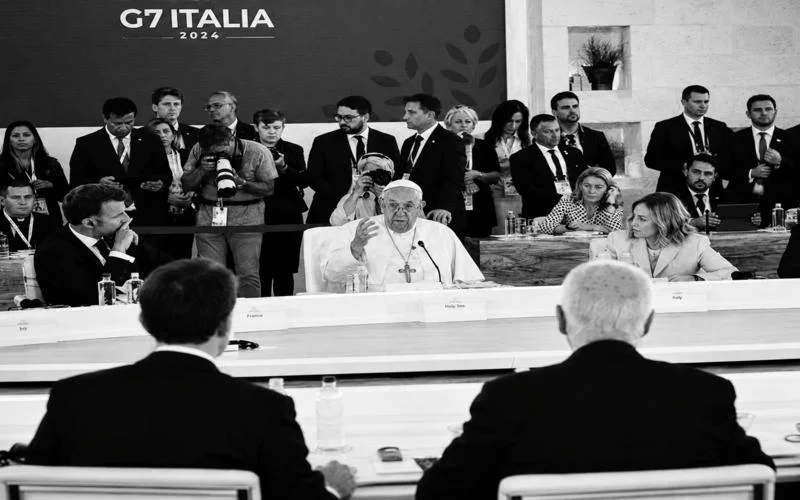
For American observers of artificial intelligence, Pope Francis’s appearance at the G7 in Puglia is not merely an unusual Vatican intervention in a diplomatic summit. It is a scene in which Italy becomes the place where three forms of power meet: political authority, moral authority and the technological power increasingly associated with the United States.
The setting matters. In June 2024, artificial intelligence is not an abstract policy issue. It is a strategic industry, a corporate race, a regulatory dilemma and a geopolitical asset. Much of its technical acceleration is being driven from the American ecosystem: Silicon Valley, frontier model companies, cloud infrastructure, venture capital and the U.S. security debate. Stanford’s 2024 AI Index gives the imbalance a numerical form: in 2023, private AI investment in the United States reached $67.2 billion, far ahead of other major economies, and 61 notable machine-learning models originated from U.S.-based institutions, compared with 21 from the European Union and 15 from China.
This is why the Italian G7 stage acquires a particular meaning in the American lens. Italy is not seen here as a technological superpower competing with the United States on models, chips or capital. It appears instead as a diplomatic and symbolic platform capable of moving the AI debate away from laboratories and boardrooms and into the language of human dignity, political responsibility and institutional control.
The presence of Francis strengthens that image. Invited by the Italian presidency, the Pope becomes the first pontiff to address a G7 summit. His intervention does not challenge innovation as such. It reframes the central question: not whether artificial intelligence can do more, but whether human beings, institutions and political systems will retain authority over what machines are allowed to decide. In American coverage, this distinction is crucial because it touches the central tension of the U.S. AI debate itself: a technology largely built by private companies, financed by enormous capital flows and deployed faster than public governance can easily absorb.
The issue becomes even sharper when the Pope speaks about autonomous weapons and decision-making. His warning that machines must not be allowed to decide over human life places the G7 discussion inside a concrete governance problem, not a theological abstraction. For U.S. policy circles and defense observers, the matter is already practical: artificial intelligence is entering military systems, surveillance, targeting support, cyber operations and risk assessment. The Italian summit therefore makes visible a question that American power cannot avoid but cannot solve alone: how to preserve human judgment when technological systems are designed precisely to accelerate, automate and optimize judgment.
In this reading, Italy appears less as the owner of the technology than as the organizer of the room in which technology is politically judged. That role should not be underestimated. The Apulia G7 communiqué commits leaders to greater interoperability among AI governance approaches, with attention to certainty, transparency and accountability. It also links AI to work, international codes of conduct and responsible development. These are not marginal diplomatic formulas. They show that the Italian presidency has placed the governance of AI alongside Ukraine, security, migration, energy and global economic resilience.
For American business observers, the reputational meaning is also concrete. AI governance is no longer only a compliance question for lawyers or a research question for engineers. It is becoming a board-level issue. Companies developing or adopting AI must now account for explainability, liability, labor impact, bias, military applications, public trust and political scrutiny. In that environment, the image of Italy produced by the G7 is not that of a passive host. It is that of a country able to turn a global technology race into a question of institutional legitimacy.
There is also a second business implication. The American AI economy is powerful precisely because it moves quickly. But speed creates exposure: regulatory fragmentation, reputational risk, lawsuits, public distrust and international pressure. When the G7 places the Pope’s moral vocabulary beside the language of democratic governance, Italy becomes the scene in which innovation is asked to justify itself before institutions older and broader than the market. For a Silicon Valley company, this may sound uncomfortable. For governments and investors, it signals that the future of AI will not be shaped only by performance benchmarks, user growth or compute capacity.
The Italian image that emerges is therefore specific. Italy is not presented as the West’s technological engine. It is presented as a country capable of convening a civilizational conversation at a moment when the technological engine is largely elsewhere. This is a subtle but valuable form of influence. It does not depend on owning the largest platforms or producing the most advanced models. It depends on transforming a summit into a stage where democratic leaders, the Vatican and the AI question are placed in the same frame.
There are limits to this image. American observers will not confuse symbolic authority with industrial leadership. The United States remains the dominant AI power; Europe remains more associated with regulation than with frontier development; Italy’s own technology ecosystem is not the central driver of the global race. But the Puglia summit suggests that international reputation is not built only through scale. It can also be built through framing.
Seen from the American side, this is the real significance of Francis at the G7. The event does not simply add a moral voice to a diplomatic meeting. It allows Italy to appear as a place where the West pauses to ask whether progress without human control is still progress. In a field dominated by American innovation, Italy’s role is not to rival Silicon Valley. It is to host the moment in which Silicon Valley’s power is placed before politics, ethics and the human person.
That is the Italy made visible in Puglia: not merely the host of a summit, but a country capable of giving a global technological question an institutional and moral setting. In June 2024, for an American debate still struggling to balance acceleration with governance, that image carries more weight than protocol.